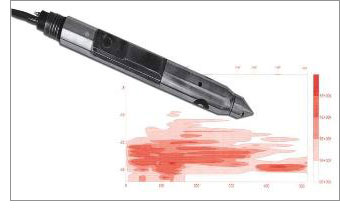
The Membrane Interface Probe (MIP) is a tool for the detection and logging of volatile organic compounds (VOCs) and chlorinated solvents in the subsurface as it is driven to depth. Compounds can be detected in either the vadose zone or saturated zone. The VOCs and chlorinated solvents are volatilized (with a heating element in the tool) and pass through the tool’s semi-permeable membrane. Compounds are then transported through the trunkline by a carrier gas to a detection system on the surface consisting of PID, FID, and DELCD detectors. A real time log provides information of the total VOCs and total chlorinated solvents detected as well as an electrical conductivity log which provides an indication of lithology encountered in the subsurface.
Capability
| • |
The MIP is a logging tool and indicates: |
|
| • |
where the contaminant is encountered at depth, |
| • |
where the contaminant is absent at depth, |
| • |
what the relative concentrations are at depth |
|
| • |
Detects VOCs in soil while driven to depth |
| • |
Can detect dissolved hydrocarbons down to 1 ppm |
| • |
Great tool for the delineation of hydrocarbon spills and plumes |
| • |
Operates both in the vadose zone and in saturated zones |
| • |
Detects soil conductivity used in lithology interpretation |
| • |
Can detect approximate water table depth |
|